
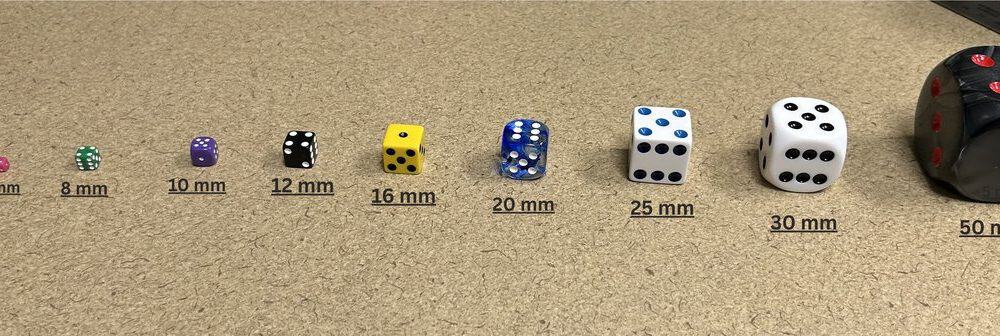
If you’ve ever ordered dice online and been surprised by how tiny, or unexpectedly large, they turned out to be, you’re not alone. Dice come in a wider range of sizes than most players realize, and that variety matters. Whether you’re rolling for initiative in a fantasy RPG or building a display collection, the size of your dice affects how easy they are to read, how satisfying they feel to roll, how much space they take up on your table, and how practical they are to carry.
This guide covers everything beginners and experienced players need to know about RPG dice dimensions, from standard polyhedral sizes to mini and jumbo specialty options, including the brands that make them.
Key Takeaways
- Dice size is measured in millimeters. For most standard dice, the official size is measured edge-to-edge (flat to flat). For other polyhedral dice (d20, d12, d10, etc.), manufacturers are less consistent and sometimes measure them point to point.
- Mini dice (5–12mm) are great for travel and large dice pools, but sacrifice readability and are easier to lose.
- Jumbo dice (25mm+) are best for collectors and display setups — they’re dramatic and highly readable but take up more table space.
- Material matters as much as size — metal and stone dice feel heavier and require a dice tray, while acrylic, resin, and glass sets are lighter and more versatile for everyday play.
What Does Dice Size Actually Mean?
Dice are measured in millimeters (mm), but what’s actually being measured depends on the shape of the die.
For d6 dice (standard six-sided dice), size refers to the edge-to-edge distance — the width of one flat face measured straight across. So a 16mm d6 is 16mm from one face to the parallel face opposite it.
For polyhedral dice (d4, d8, d10, d12, d20), the measurement is typically point-to-point — the distance from one vertex to the opposite vertex or face. This is why a 20mm d20 and a 16mm d6 can look similar in size even though their numbers differ; they’re measuring different things.
Quick examples:
- A standard 16mm d6 fits comfortably in your palm
- A 20mm d20 is roughly the size of a large marble
Understanding this helps when shopping, because “16mm” means something slightly different depending on which die type you’re looking at.
Millimeters to Inches: A Quick Reference
Most dice are labeled in millimeters, but if you think in inches, here’s how the most common sizes translate. While these are the most common sizes, Dice Emporium does carry additional sizes as well. Bookmark this table for quick reference any time you’re comparing sizes while shopping.
| Dice Size | Approximate Inches |
|---|---|
| 5mm | 0.20″ |
| 8mm | 0.31″ |
| 10mm | 0.39″ |
| 12mm | 0.47″ |
| 16mm | 0.63″ |
| 20mm | 0.79″ |
| 25mm | 0.98″ |
| 30mm | 1.18″ |
| 50mm | 1.97″ |
A good rule of thumb: most standard dice cluster around the 0.6″–0.8″ range, while anything under 0.5″ counts as mini and anything over 1″ is solidly in jumbo territory.
Standard RPG Dice Sizes/Common Polyhedral Dice Dimensions
Most commercially sold RPG dice sets fall within a fairly consistent size range. These “standard” dimensions are sized to balance readability, portability, and comfortable rolling.
| Die Type | Typical Size | Approximate Inches |
|---|---|---|
| d4 | 18–20mm | 0.71″–0.79″ |
| d6 | 16mm | 0.63″ |
| d8 | 15–16mm | 0.59″–0.63″ |
| d10 | 16mm | 0.63″ |
| d12 | 18mm | 0.71″ |
| d20 | 20mm | 0.79″ |
These dimensions work well with most dice trays and towers available on the market. A dice tower designed for standard polyhedral sets will typically accommodate any dice in the ranges above without issue.
The 16mm d6 is by far the most universal die size you’ll encounter; it’s the standard for board games, RPGs, and casual play alike. The d20’s slight size bump to 20mm reflects its status as the centerpiece die of most fantasy RPGs; manufacturers often give it a little more real estate so the numbers stay readable through heavy use.
Two of the most trusted names in standard-size dice are Chessex dice, known for their iconic marbled and speckled finishes, and Koplow dice, a long-running manufacturer popular for vibrant opaque and translucent colorways.
Browse standard polyhedral dice sets at Dice Emporium
Mini Dice vs. Standard Dice
What Counts as Mini Dice?
Mini dice fall below the standard size range. Common mini dice sizes include:
- 5mm — the smallest commercially available; roughly the size of a pea
- 8mm — small but still rollable; popular for travel kits
- 10mm — a common “travel size” sweet spot
- 12mm — just slightly below standard; easier to handle than smaller minis
Pros and Cons of Mini Dice
Benefits: Mini dice are genuinely practical in several situations. They’re ideal for travel since an entire set fits in a tiny pouch or even a pill case. They’re also popular among players who roll large dice pools — some RPG systems call for 10 or 20 dice at a time, and mini d6s let you roll them all at once without scattering them across the room.
Drawbacks: The trade-off is readability. Numbers on 5–10mm dice are genuinely difficult to read, especially in dim lighting. They’re also easy to lose — we’re talking about objects smaller than a fingernail. And there’s the feel factor: rolling five tiny dice doesn’t carry the same satisfying clatter as five standard ones.
Shop mini dice sets at Dice Emporium
Jumbo and Oversized Dice
Jumbo dice start at around 25mm and go well beyond, and some novelty and display dice reach 50mm or larger.
The most common oversized sizes you’ll encounter are 25mm and 30mm. Beyond that, you’re typically in novelty territory: foam dice for classrooms, decorative wooden dice for shelves, and the eye-catching centerpiece dice that game masters love to set in front of their screen.
Common uses for oversized dice:
- Tabletop centerpieces
- Display collections and shelf décor
- Streaming and video setups (oversized dice read clearly on camera)
- Gifts for tabletop gaming fans
- Classroom learning tools
Are Oversized Dice Practical at the Table?
They can be, with some caveats. Oversized dice are significantly easier to read, useful for players with vision difficulties or in low-light gaming environments. The heavier roll of a 30mm die feels dramatic and satisfying. But they take up real table space, and if you’re playing at a crowded table with maps, minis, and snacks already competing for space, a set of 30mm dice can feel like too much.
For most players, oversized dice make more sense as collector pieces or accent dice (one big d20 for important rolls) rather than a full set replacement.
Shop jumbo dice at Dice Emporium
How Dice Material Changes the Feel of Size
Two dice can be the exact same size and feel completely different based on what they’re made of. Material weight affects how dice roll, how loud they are, and how much they wear over time.
Acrylic and Resin Dice
Acrylic is the most common dice material and the standard for most sets. It’s lightweight, affordable, and available in virtually unlimited colors and finishes. At 16–20mm, acrylic dice feel “normal” in the hand — not too heavy, not too light. Resin dice, often used for artisan sets with inclusions (flowers, glitter, metallic swirls), are similar in weight to acrylic but tend to have slightly softer edges.
Metal Dice
Metal dice are noticeably heavier at the same dimensions. A 16mm metal d6 can weigh three to five times more than its acrylic equivalent. That weight translates to a louder, more satisfying roll, and significantly more wear on unprotected table surfaces. Metal dice are almost always used with a dice tray for this reason.
Glass Dice
Glass dice offer a different kind of premium feel — cool to the touch, often crystal-clear or richly colored, and with a smooth, almost frictionless roll. They tend to sit closer to acrylic in weight but feel more substantial and refined in hand thanks to the density of glass. We’re actively growing our glass dice sets selection, so check back as new styles are added.
Stone and Gemstone Dice
Stone and gemstone dice are the densest option available. Onyx, obsidian, malachite, and similar materials create dice that feel genuinely premium in hand. Because of their density and hardness, stone dice need to be rolled on padded surfaces — they’ll scratch wood and chip on hard surfaces. The added weight makes larger sizes (20mm+) feel especially substantial.
Shop metal dice at Dice Emporium | Shop gemstone dice at Dice Emporium
Choosing the Right Dice Size for Your Play Style
Best for Beginners: Standard 16–20mm Sets
If you’re new to RPGs, start with a standard polyhedral set in the 16–20mm range. These are the most readable, the most compatible with accessories like dice towers, and the easiest to find. Dice Emporium’s beginner sets include all seven standard polyhedral types (d4, d6, d8, d10, d12, d20, and percentile d10) in standard sizing, including trusted brands like Chessex and Koplow.
Best for Travel: Mini Dice (10–12mm)
For gaming on the go — at a convention, on a long trip, or at a coffee shop — a 10mm or 12mm mini set fits in any bag. Pair them with a small notebook and you’ve got everything you need for a session anywhere.
Best for Collectors: Oversized or Specialty Dice
If you love dice as objects — their weight, craftsmanship, and visual impact — oversized and specialty dice are where collecting gets genuinely interesting. A 30mm gemstone or glass d20 is a conversation piece on its own. Many collectors also gravitate toward specialty dice in unusual materials or with custom engravings.
Best for Large Dice Pools: Smaller d6s
Games requiring 10+ dice per roll are much more manageable with 10mm or 12mm d6s. You can fit them all in one hand, roll them in a single throw, and count results without chasing dice around the table.
Dice Sizes Explained: Final Word
Dice size affects more than you might expect — readability, portability, rolling satisfaction, and how your table looks all change depending on what you’re rolling. Standard 16mm–20mm polyhedral sets cover most players’ needs, but there’s genuine value in going smaller for travel or larger for display and drama.
The best approach? Most tabletop veterans own dice across multiple size categories, each suited to a different context. A mini set for conventions, a standard set for regular sessions, and a few oversized pieces for special occasions.
Whether you’re looking for standard RPG dice from trusted names like Chessex and Koplow, miniature travel sets, or oversized collector dice, Dice Emporium offers thousands of dice styles and specialty options for every type of tabletop gamer. Shop all dice or explore our new arrivals to find your next favorite set.
Frequently Asked Questions About Dice Sizes
1. What size are standard D&D dice?
Standard dice for D&D and similar fantasy RPGs typically range from 15–20mm (about 0.6″–0.8″) depending on the die type. The d20 — the most iconic die in the game — is usually around 20mm, while d6s and d8s typically land at 15–16mm. Most commercially sold sets, including those from Chessex and Koplow, fall within this range.
2. Are bigger dice more random?
No. Randomness in dice rolls comes down to manufacturing quality, not physical size. A precision-manufactured 16mm die with sharp edges and consistent weight distribution will roll more fairly than a poorly made 30mm die. Look for dice made with high-quality molds and consistent finishing regardless of size.
3. What size dice are easiest to read?
Dice in the 25mm–30mm range (roughly 1″–1.2″) are generally the easiest to read. The numbers are large enough to see clearly across a table, even in lower light. If readability is your top priority — due to vision needs or gaming in dim environments — a jumbo set offers the best visibility.
4. Are mini dice harder to roll?
Mini dice (especially 5mm–8mm) can be harder to handle physically — they’re more difficult to pick up off a surface and easier to fumble. They also tend to travel further when rolled since they’re light, making them harder to contain without a dice tray or tower. Most players find 10mm–12mm to be the smallest comfortable rollable size.
5. Can I use different dice sizes in the same set?
Absolutely. Many experienced players mix sizes intentionally — using a jumbo d20 as their “fate die” for big moments while rolling standard-sized supporting dice. There’s no rule requiring a matched set, and mixing sizes is a practical way to make your most-used dice easier to track at the table.